Assagioli’s Egg Diagram: A Map of the Human Psyche and the Path to Wholeness
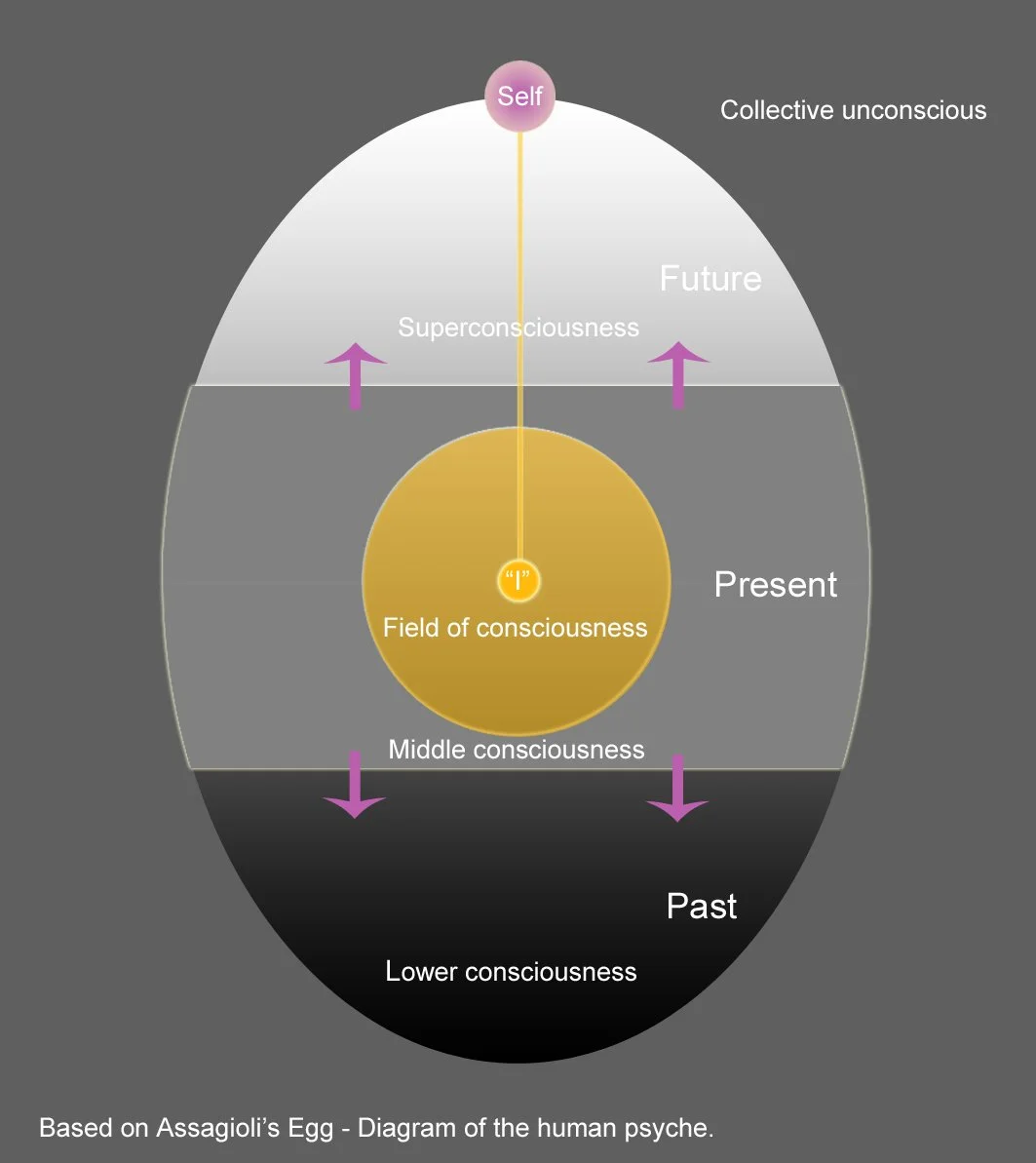
Who are we, really?
Are we simply our thoughts, emotions, memories, and experiences? Or is there something deeper within us—a centre of awareness that remains present, even as everything else in our lives changes?
These are some of the questions that the Italian psychiatrist Roberto Assagioli, the founder of Psychosynthesis, began exploring in the early twentieth century.
As he searched for a more complete understanding of the human psyche, he created what looks like a simple diagram. Today, it is known as the Egg Diagram.
But behind its simplicity lies a much deeper idea. The diagram is a kind of map of our inner world. It shows different layers of our psychological life, while also pointing towards our potential for growth, creativity, meaning, and spiritual development.
Why an Egg?
The egg is a symbol of potential.
Just as an egg contains the hidden possibility of life waiting to unfold, each of us carries abilities, wisdom, creativity, and possibilities that may not yet be fully developed or even recognised.
For Assagioli, our psyche is much larger than the part of ourselves we are consciously aware of in everyday life.
What we know about ourselves is only a small part of a much larger inner world.
The Lower Unconscious: Where Our Wounds Reside
At the bottom of the Egg Diagram is the Lower Unconscious.
This is where we can find experiences that we have pushed away because, at the time, they were too painful, frightening, or overwhelming to face.
It can include our fears, emotional wounds, instincts, automatic reactions, and unresolved inner conflicts.
Many approaches to psychotherapy focus strongly on this part of the psyche. And for good reason. What remains unconscious can have a powerful influence on how we relate to other people, how we make decisions, and how we see ourselves.
But for Assagioli, healing these wounds is only one part of the journey.
There is much more to us than what has been hurt.
The Middle Unconscious: Our Inner Library
Above the Lower Unconscious is the Middle Unconscious.
This part contains what we have learned, experienced, and developed throughout our lives—our memories, knowledge, skills, habits, and abilities.
We are not constantly thinking about all of this, but we can bring much of it into our conscious awareness whenever we need it.
When we speak our native language, ride a bicycle, play a musical instrument, or remember a friend's phone number, we are drawing on this part of ourselves.
You could think of it as an inner library, holding the knowledge and experience we have gathered throughout our lives.
The Field of Consciousness: What We Experience Right Now
In the centre of the Egg Diagram is the Field of Consciousness.
This is everything we are aware of in the present moment: our thoughts, emotions, bodily sensations, desires, perceptions, and images.
And this field is constantly changing.
A thought appears and disappears. An emotion rises and eventually passes. Our mood changes. Our body feels different from one moment to the next.
But this raises an interesting question:
If all of these things are changing, who is the one noticing them?
The Personal Self: The Inner Observer
At the centre of the Field of Consciousness, Assagioli places the Personal Self, or simply the “I.”
This is not the ego in the usual sense of the word.
Instead, it is our centre of awareness and will—the part of us that can observe our experience without being completely absorbed by it.
For example, there is a difference between saying:
“I am afraid.”
and being able to say:
“I notice that I am feeling afraid.”
There is also a difference between:
“I am a failure.”
and:
“I am having the thought that I am a failure.”
In the second example, we have created a little more space between ourselves and what we are experiencing.
One of the best-known principles of Psychosynthesis expresses this beautifully:
“We are dominated by everything with which we identify. We can dominate and control everything from which we disidentify.”
As we gradually learn to step back from our thoughts, emotions, beliefs, and social roles, we can begin to discover a deeper and more stable sense of who we are.
We are not our thoughts.
We are not our emotions.
We are not only our roles, our past, or the labels we have been given.
There is something within us that can observe all of these experiences.
The Superconscious: Our Highest Potential
One of Assagioli’s most original contributions to psychology was his idea of the Superconscious.
Traditional psychological approaches have often focused on suffering, trauma, conflict, and psychological limitations. Psychosynthesis does not ignore these things, but it also asks a different question:
What is possible for us when we begin to heal?
The Superconscious represents our higher human capacities. It is associated with:
intuition;
creative inspiration;
love;
compassion;
wisdom;
inner peace;
a sense of meaning and purpose;
spiritual insight.
Most of us have probably experienced moments that seem to come from this part of ourselves.
Perhaps it happens while creating something, experiencing deep love, feeling profound gratitude, connecting with nature, or suddenly seeing the answer to a question that we have been struggling with for a long time.
According to Assagioli, these experiences are not simply strange or unusual exceptions.
They are natural expressions of the human psyche.
The Higher Self: A Source of Inner Guidance
At the top of the Egg Diagram is the Higher Self.
This is perhaps one of the most subtle and profound ideas in Psychosynthesis.
The Higher Self is not a separate being living somewhere outside of us. Rather, it represents the deepest dimension of our own nature—the part of us that remains whole regardless of what happens in our lives.
Our successes, failures, losses, relationships, disappointments, and challenges may all change us, but according to Assagioli, they do not destroy this deeper centre.
Assagioli often used the image of the sun reflected on water to explain this.
The sun represents the Higher Self.
Its reflection in the water represents the Personal Self.
When the water is disturbed, the reflection becomes distorted. When the water becomes still, the reflection becomes clearer.
In a similar way, when our inner life becomes more harmonious, we may begin to experience our own inner wisdom and guidance more clearly.
The Collective Unconscious
Surrounding the entire Egg Diagram is the Collective Unconscious.
This is the shared psychological field that connects us with other human beings through universal symbols, archetypes, and our common human experience.
It reminds us that we are never completely separate from the world around us.
We each carry our own personal history, but we also carry something of the larger human story.
The Aim of Psychosynthesis
Many people think of psychotherapy primarily as a way to reduce suffering.
And certainly, healing our wounds and understanding the patterns that cause us pain are important parts of the process.
But Psychosynthesis offers a broader vision.
It asks not only:
“How can I heal what is hurting?”
but also:
“Who am I capable of becoming?”
The aim is integration—bringing together the different parts of our personality around a more stable inner centre.
This can mean learning to acknowledge our shadow without allowing it to define us. It can mean developing our unique abilities and gifts, connecting with our inner wisdom, and finding ways to live in greater harmony with ourselves and with the world around us.
In this sense, psychological growth is not simply about getting rid of what is difficult.
It is also about discovering and developing what is already alive and healthy within us.
Why Does the Egg Diagram Still Matter Today?
We live in a world that constantly encourages us to define ourselves through our careers, achievements, relationships, appearance, social roles, and external success.
Assagioli’s Egg Diagram offers a different perspective:
We are so much more than what we have achieved.
We are more than our fears.
More than our past.
More than our mistakes.
More than the roles we play in our everyday lives.
Within every human being there is a part that may need healing—and also a part that longs to grow, develop, create, and unfold.
This is one of the things that makes Psychosynthesis so meaningful to me.
It does not ask us to ignore our wounds or difficult experiences. Instead, it invites us to meet them with awareness and compassion while also remembering that they are not the whole of who we are.
There is something within us that is capable of healing.
Something capable of creating.
Something capable of loving, growing, and discovering new meaning.
Perhaps this is the greatest message of Assagioli’s Egg Diagram:
The journey towards psychological well-being does not end when our suffering becomes smaller.
It continues as we gradually discover who we are beneath our identifications, awaken our deeper potential, and begin to create a life that is more conscious, authentic, and whole.